

Doonails solved a small but persistent self-care problem for me. Then, because I apparently cannot enjoy anything casually, I turned that solution into a field study—and a test of what it might look like to collaborate with AI on a real content project.
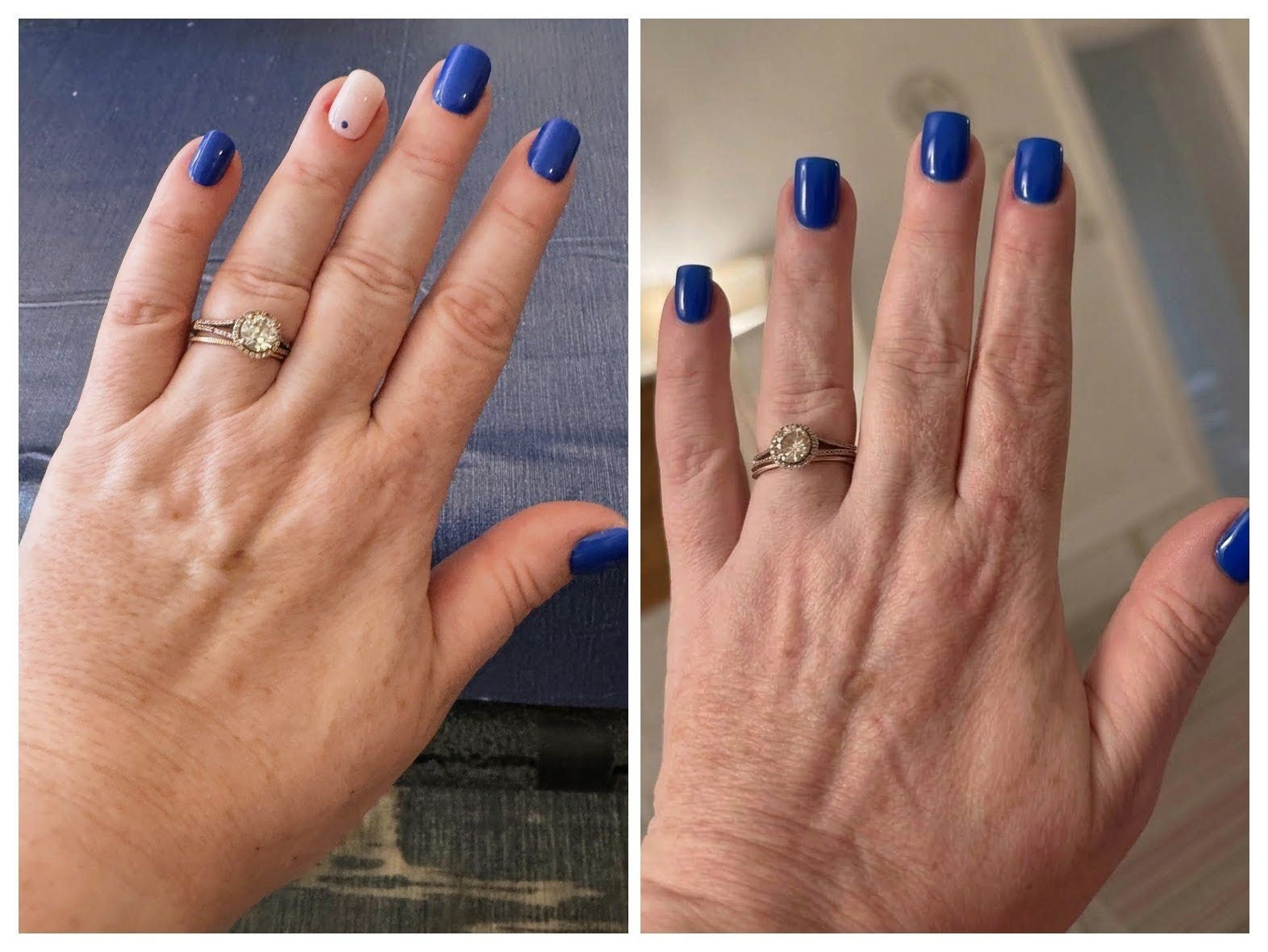
My real Blue Santorini Extra Short Square manicure with a Blue Dots Extra Short Square accent nail (left) and the Doonails AI preview (right). The cobalt is remarkably close; the accent was my own combination.
Please forgive me while I geek out here. I used to do a lot of alpha and beta testing for startups. I kind of can’t help myself. 🤪
My current—possibly unhealthy—obsession is Doonails: reusable soft-gel press-on nails. I attach mine with adhesive tabs. No nail glue. No curing lamp. (FWIW, also no judgment if you do you with glue—or a curing lamp, too.)
Best part: no appointment. No sitting across from a stranger while both of us pretend not to notice that I have once again mangled my cuticles.
I realize that “reusable soft-gel press-on nails” is not an obvious gateway to a sprawling content project. And yet, here we are.
The self-care problem
I like having my nails done. I just never really had a person for nails—the reliable provider you trust enough to make the whole thing personal versus just another transaction. I am a big believer in having “a person”, and have personally followed my hairstylist across—and occasionally beyond—the state for close to 20 years.
For a while, my occasional indulgence was a favorite bougie neighborhood nail salon. White surfaces, clean edges, no clutter—just perfectly lined-up colorful bottles of polish arranged tonally in a cohesive, calming presentation. A gel manicure and regular pedicure, including the tip, run just north of $100 around here, so this was never part of my normal maintenance budget. My mom had given me a gift certificate, and I was looking forward to using it for a rare treat.
Then I missed the appointment.
It was part online-booking confusion—I had entered the wrong date and time—and part actual family emergency: I ended up having to take my daughter to the emergency room. In the middle of that, I forgot to untangle the appointment issue before the cancellation window closed.
The salon charged my card for the missed service.
I understood the policy. I also understood that I had now paid more than $100 for a manicure and pedicure I did not receive. Adding insult to injury, I still had the original gift certificate, which meant I had to go back one last time if I wanted to use the money my mom had already spent.
I also tried two other salons with a good friend who liked both places enough to return while remaining open to trying somewhere new. For me, those excursions were about spending time with a fellow member of my mom coven. A good mani-pedi experience was a welcome bonus, but it wasn’t make-or-break for the afternoon.
At one appointment, the nail tech commented on the amount of dead skin on my feet and suggested that I come in more often to address it. Fair play—he looks at feet all day. I didn’t disagree. But as he directed where and how I should place my feet and hands with curt, firm taps and tiny grunts—the nail-salon equivalent of an inconsiderate ballroom lead—I knew we weren’t a stylistic match. No shade; we all have our ways. The directive approach just wasn’t my vibe.
So there was my very minor but very real self-care problem. I wanted pretty hands and feet. Salon visits were expensive, logistically fragile and not reliably relaxing. Painting my own nails had never worked especially well for me. My nails are brittle, my nail beds are short, and regular polish seems able to detect the precise moment I begin to believe it might survive.
Then I found Doonails. Or rather, the algorithm tipped them off, and they hunted me across the internet until I relented and made that first purchase.
A small luxury that fits inside real life
Doonails did not transform me into someone who has hours of uninterrupted leisure or a standing beauty appointment. They gave me a version of nail care that can bend around the life I actually have.
I can apply them at home, at night, after the urgent things are done—or first thing in the morning, in that sweet little window between getting my daughter off to school and starting work. I can stop and deal with a kid issue. I can choose a dramatic color without committing to it for three weeks. I can remove them without grinding another layer off already-fragile nails. And once I learned the technique, I could get a polished result that made me feel noticeably more put together.
That last part sounds superficial until you have spent a stretch of life treating your own care as the first thing that can always be postponed. A small, visible thing that is only for you is not nothing.
Of course, I did not simply find one set I liked and move on with my life.
I started comparing shapes. Then lengths. Then colors against my skin tone. Then adhesive-tab sizes, prep methods, application order, wear time, removal, storage and reuse. I started recording what held up through laundry, swimming, exercise, cleaning, lifting and the kind of chores that require actual finger dexterity. I noted what was flattering, what was fun, what was easy to clean and what looked lovely online but washed me out in person.
There is now a spreadsheet.
There is also a guide.
Because apparently my idea of enjoying a consumer product is to conduct an unpaid longitudinal study of it.
The other experiment hiding inside the nail experiment
The guide is also my test case for a larger question: Can I use AI to help me structure ambitious content projects without allowing AI to flatten my voice, invent authority I do not have or quietly lose the good material along the way?
I am not a nail technician. I am not pretending to be one. Fast-forward through a couple dozen logged manicures, pedicures and combinations, and I remain a busy mom with brittle nails and extremely specific opinions earned through trial, error and occasional profanity.
That makes this a useful pilot project. The subject is low-stakes enough to play with, but the underlying content problem is real. I have product notes, photos, wear logs, half-finished observations, Facebook group posts, instructions, corrections and ideas scattered across formats and conversations. I want to see whether AI can help me turn that pile into something coherent and genuinely useful—the unofficial user guide I wish I had when I started—while preserving the funny asides, the reversals, the “actually, I changed my mind” moments and all of the unglamorous details that make it mine.
So far, I am using AI less like an oracle and more like a very patient editorial operations partner. It helps me sort and cross-reference notes, spot contradictions, build trackers, maintain a parking lot for future ideas and test different structures. I still make the judgments. I still correct it. Frequently. The experiment is partly about discovering what it does well—and partly about designing safeguards for the moments when it confidently does not.
That is why the latest feature on the Doonails website delighted two separate parts of my brain at once.
Doonails added an AI playground
Some really cool features appeared on the Doonails website last night, built around an AI tool that can render different sets on a photo of your own hand.
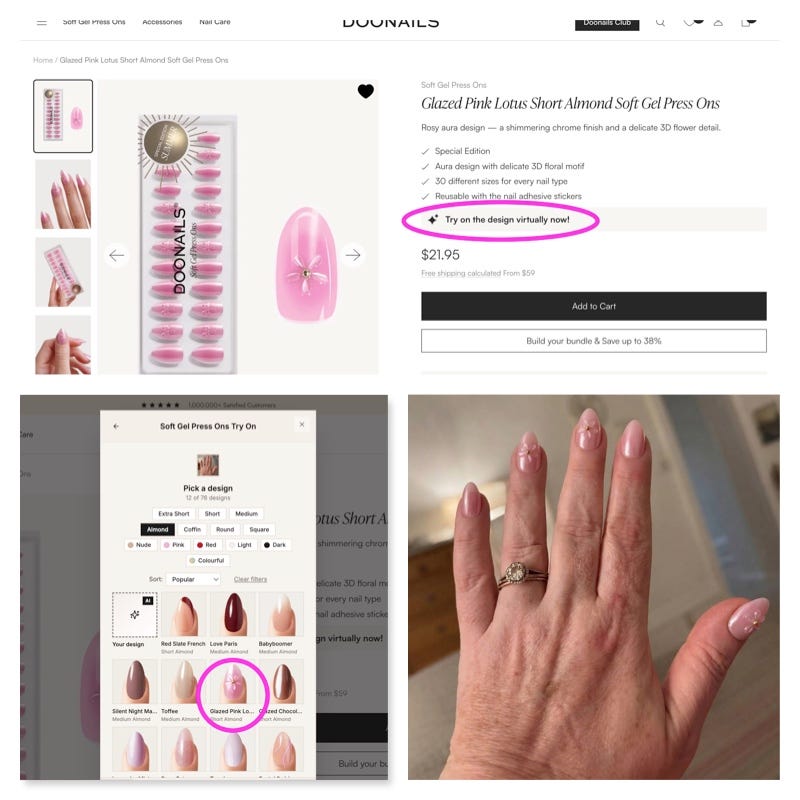
The try-on link appears on individual product pages and opens a menu that lets you filter the current catalog by length, shape and color.
Apologies in advance to anyone else who is as vulnerable as I am to a shiny new feature. Consider your evening spoken for.
You can virtually try on styles from the shop, filter them by length, shape and color, and get an estimated size guide for each finger. The tool also offers personalized tips for maximum wear.
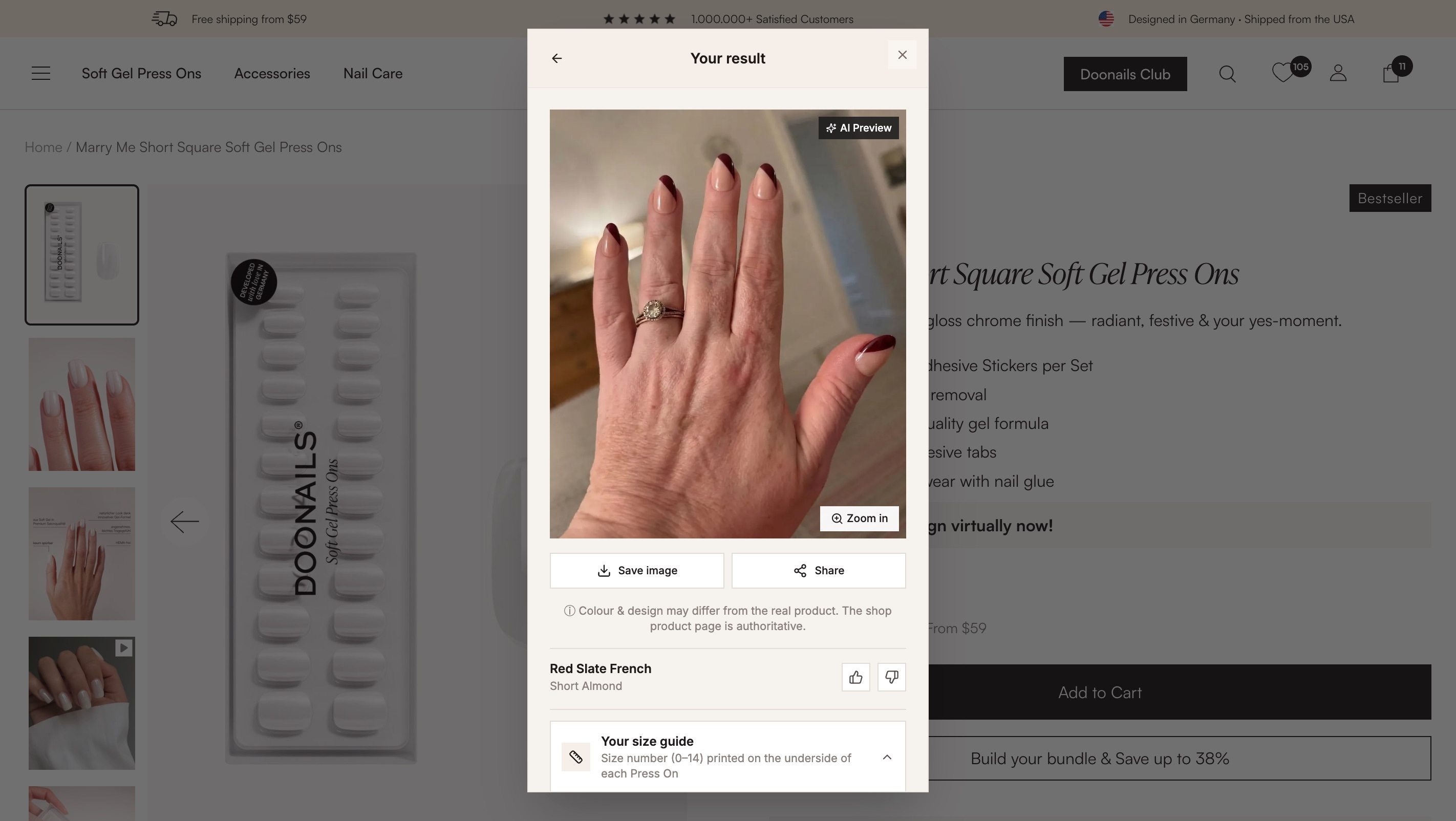
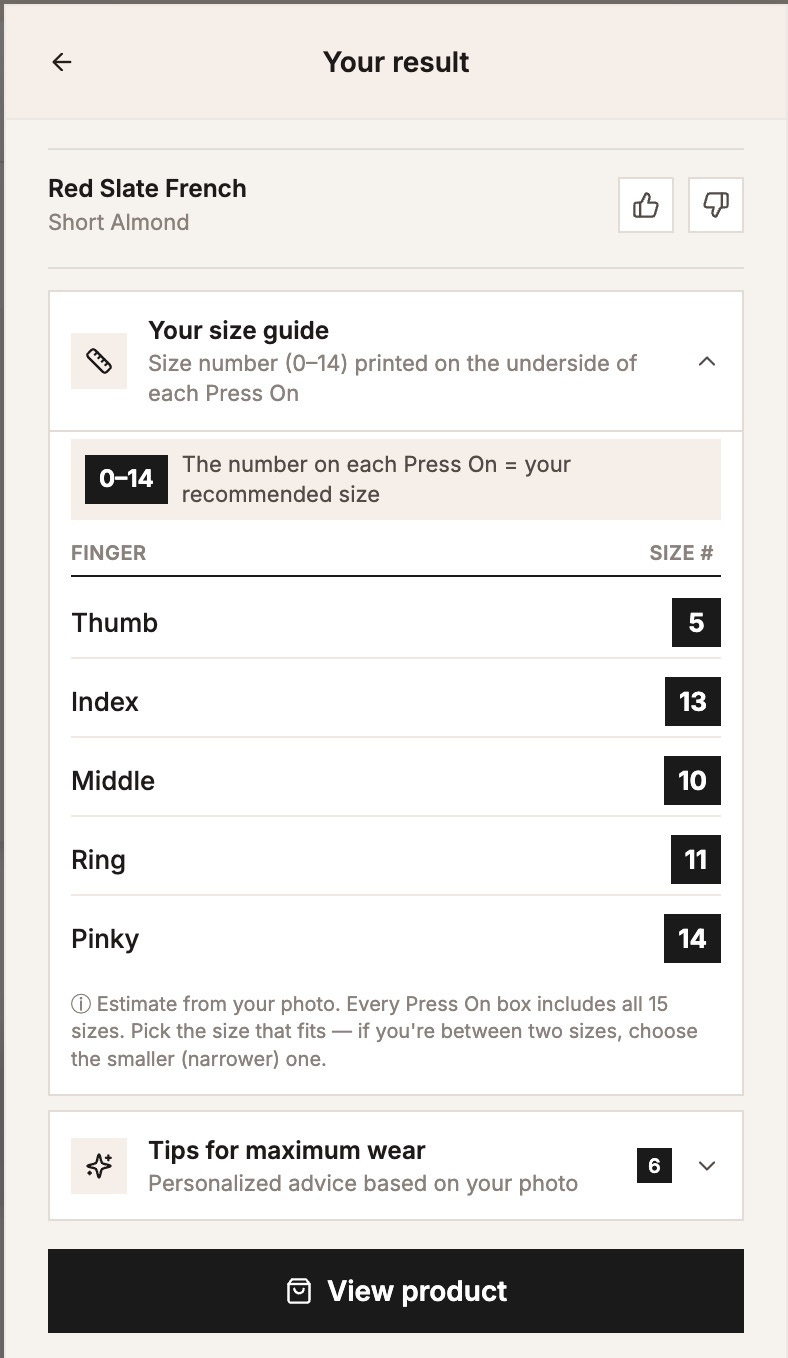
The tool also estimates a press-on size for each finger and offers personalized wear tips.
Then there is the feature most likely to consume an unreasonable amount of time: you can describe a nail design that does not exist in the shop, choose a shape and length, and ask the AI to paint your imaginary set onto your hand
To be clear, those custom creations are previews, not products you can order. Which is probably wise. I do not need both an AI design studio and an Add to Cart button operating in the same browser window.
The custom-design tool is also interesting from the other side of the screen. Users are effectively showing Doonails which colors, finishes, shapes and combinations they want badly enough to invent. I have no idea whether the company plans to use that information for product development, but the feature could become a remarkably efficient source of customer-demand data.
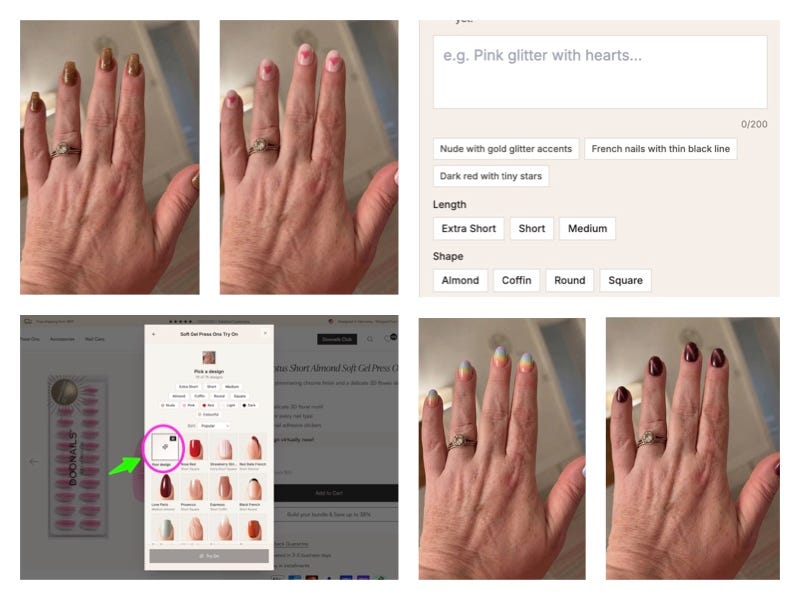
The custom-design process and a few of the entirely imaginary sets I made with it. These are AI previews, not products currently sold by Doonails.
Naturally, I wanted to know how accurate the virtual try-on feature was. I tried styles in the tool and compared the renderings with my own photos of the actual sets on my actual hand.
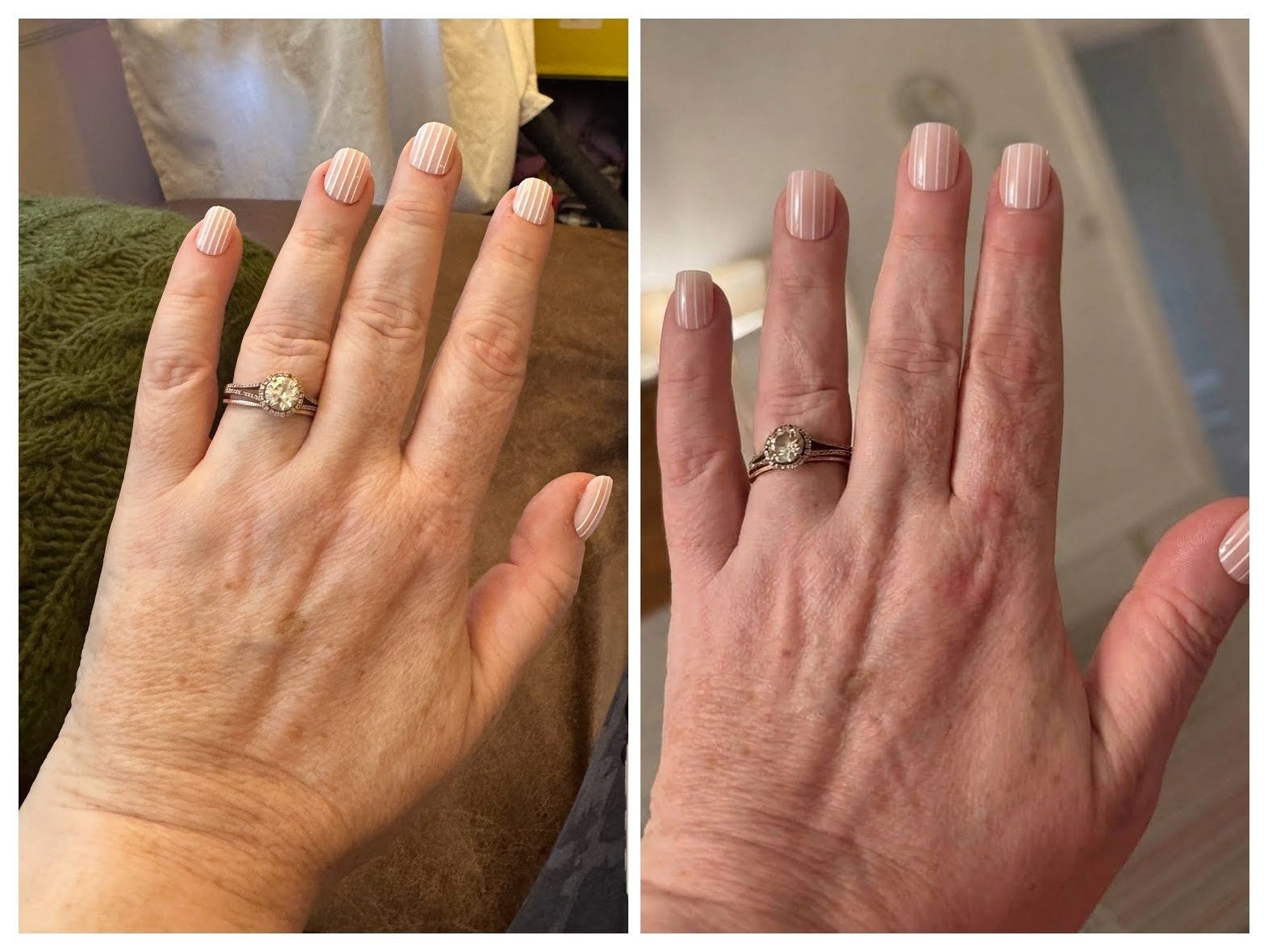
Strawberry Stripes Extra Short Square in real life (left) and in the AI preview (right): a particularly close match in color, pattern, shape and length.
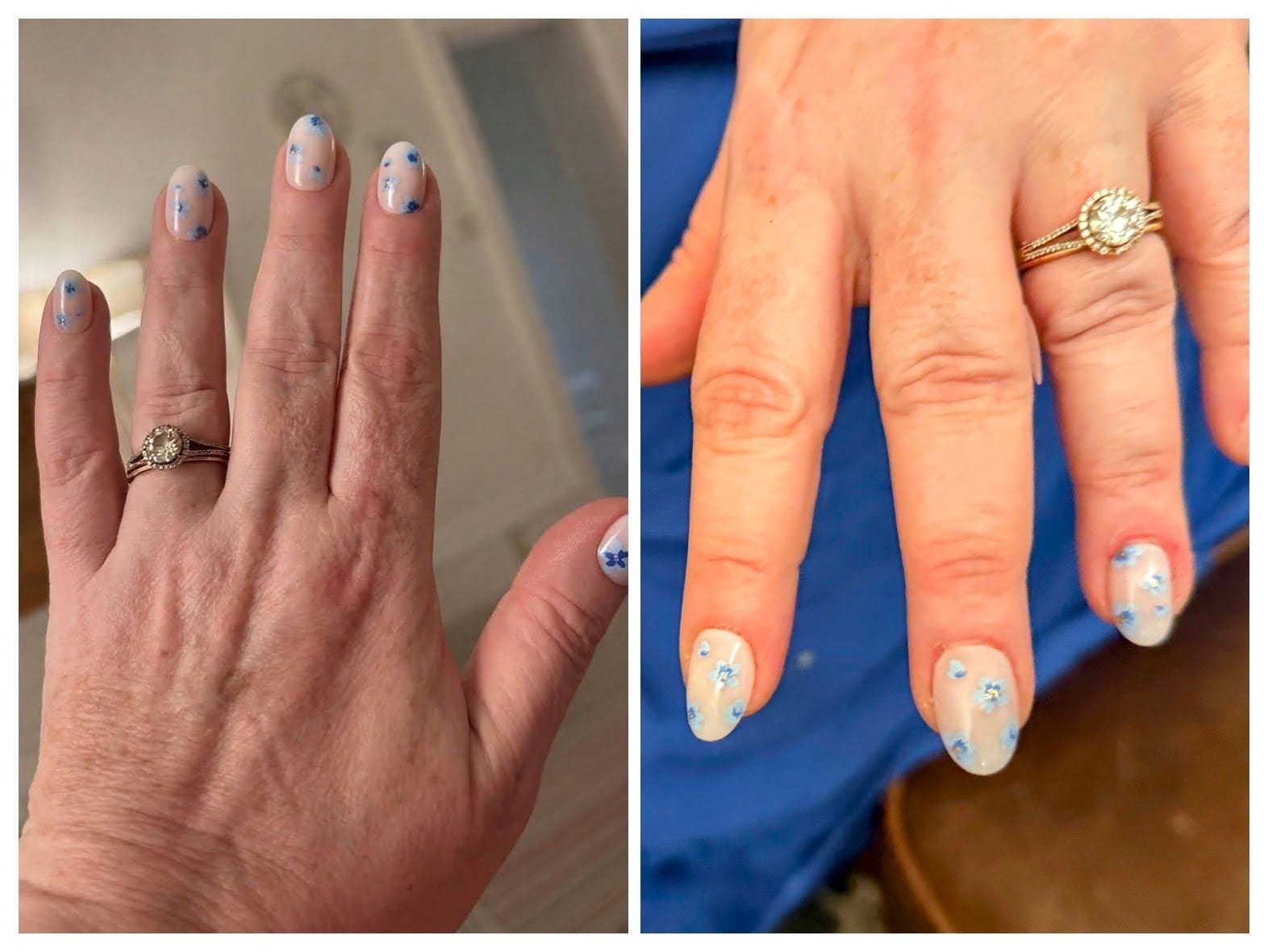
Blossom Babe Short Round in the AI preview (left) and during actual wear (right). The design translates well, but the real short-round shape reads longer and more tapered.
It is not perfect. Some combinations of shape, length and color render more faithfully than others. But for an initial rollout, it is really good—good enough to give a shopper a much better first impression than a product photo on someone else’s hand.
The catalog try-on absolutely would have saved me from a few bad color matches. It also would have converted me on styles I never would have put in my cart otherwise, so I suppose that is a wash rather than a savings. The house always wins.
The especially interesting part is that I now have something better than a vague opinion about the feature. Because I already photograph and track my sets, I can compare the virtual version with the real result. Where does the color shift? Does “short” look like the actual short length? Does an almond shape become too pointy? Does the model preserve the relationship between nail width, nail bed and finger shape?
I imagine those real-world comparisons—and feedback from many different hands and skin tones—could help the team identify what the model gets right and where it needs refinement. Even in its current form, though, the feature reduces one of the hardest parts of buying nails online: trying to translate a beautiful product image into an answer to the much more personal question, But what will that look like on me?
And that is how my press-on nail obsession became an AI experiment nested inside another AI experiment.
One experiment is about whether a model can show me the nails before I buy them. The other is about whether a model can help me turn months of enthusiastic overthinking into a guide worth reading.
Both are still works in progress.
So am I.
But my nails look fantastic. 💅
P.S. - A quick disclosure: This post is not sponsored; I bought my Doonails with my own money. My referral link gives new customers $15 off a first order of $60 or more, and I’ll receive the same discount on a future order if you use it.