

Author’s note: The views expressed here are entirely my own and are not made on behalf of, or in association with, any past, present or future employer, client, or organization.
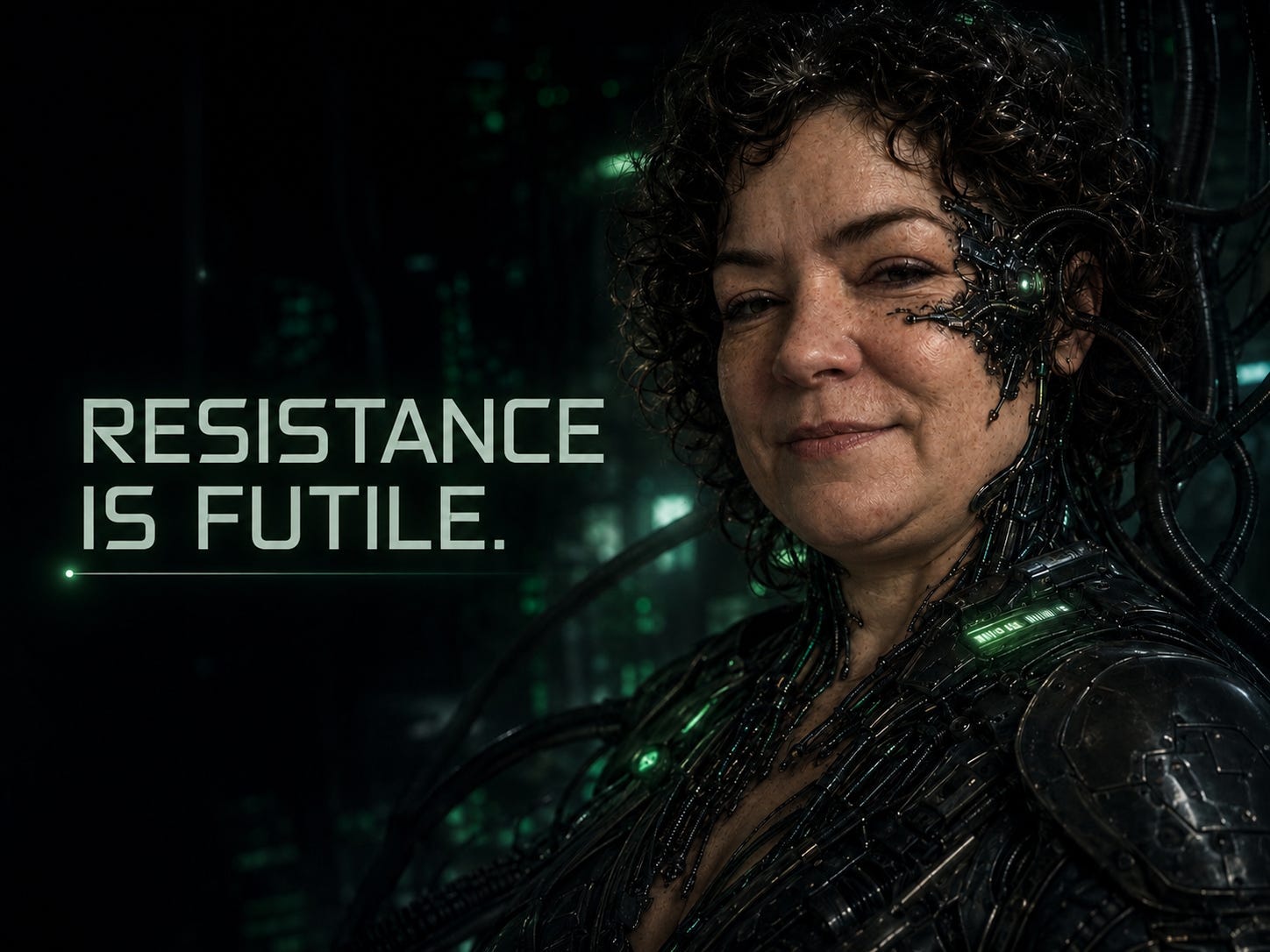
Have you heard? The AI B0rg Collective lurched beyond all of our supposedly sovereign borders while we were sleeping, ominous dissonant droning scoring its arrival.
Unfortunately, nobody appears to have sent the diplomatic envoy with heads of state to the water’s edge to greet it. I hear Picard and Riker are temporarily indisposed in the head with a copy of War and Peace, so we may be on our own.
We are late to the reception, not early to the invasion.
So, now that the cube has breached the perimeter, how do we prepare to meet this newfangled collective beast?
Do we put the coffee on? Latte, cortado, or Americano? Whole milk or oat? Sugar? How, exactly, does the Collective take its cup of joe?
This is more or less the question rattling around my head while my husband binge-rewatches Star Trek: The Next Generation for the unknowable-teenth time and I use artificial intelligence to organize, retrieve, test, draft, argue with, and occasionally horrify myself.
I am not standing on a hill shouting that the machines are coming. I am in the whale’s belly, studying the digestive tract. And I am painfully aware that none of this is neutral.
AI is already rearranging labor, authorship, education, disability accommodation, search, publishing, energy demand, privacy, creativity, expertise, and the ordinary experience of thinking with a machine nearby. Some of those changes are extraordinary. Some are dangerous. Most are both more complicated and more mundane than the loudest people on either side would have us believe.
But let’s get real here for a moment, dear internet friend: my abstaining will not stop any of the negative consequences marching our collective way. It will only leave me less prepared to understand and brace for what is coming.
I would rather be on the away team
One cautious response to technology is to treat nonparticipation as moral cleanliness: do not use the thing and therefore do not become implicated in the thing.
I understand the instinct. I do not think it gets us very far.
It is best not to try to install meaningful guardrails around a system until you know its topography like the back of your hand. You cannot translate its risks for ordinary people if your knowledge begins and ends with someone else’s warning label. You cannot participate intelligently in policy debates about form and function if you have refused to look closely at either.
And there are real opportunities for the people who learn early. Personal ones, certainly. Economic ones. Creative ones. But also civic ones: the opportunity to translate a strange and fast-moving technology into digestible warnings; to identify where guardrails actually belong; to ask what regulation can realistically do; to distinguish a moral panic from a genuine threat; and to notice harms that become obvious only when you have lived alongside the tool long enough to see where it quietly changes your behavior.
I, for one, do not want the only people on the away team to be the people selling tickets for the ship.
Federation questions
Maybe this is why I have been hearing the whispers of Star Trek’s imaginary, utopian-adjacent structures through whatever piece of Borg hardware is apparently lodged behind my ear.
The Federation is not compelling because it discovered a way to avoid the unknown. Its organizing premise is the opposite: the unknown is out there, sentient beings are going to encounter one another, technology will keep expanding what is possible, and somebody has to build structures for navigating the consequences.
Exploration needs rules. Contact creates obligations. Capability is not the same thing as permission.
That is where I keep landing with AI.
What does this cost? How do we split the bill? What positive effect can it have? How do we share that wealth? Who gets the productivity dividend? Who loses work, status, bargaining power, privacy, authorship, water, energy, habitat, or attention along the way? Who decides what counts as an acceptable trade?
Those are human-rights questions. They are labor questions. They are disability questions. They are environmental questions. They are copyright questions. They are democratic-governance questions.
And then there are the migrating birds.
Who is the guardian ad litem for the migrating birds?
A migrating bird does not get to attend a zoning hearing. It cannot negotiate the placement of a data center. It cannot object to changes in water use, heat, habitat, light, noise, or the infrastructure built along its route.
It can still absorb the cost. The bird still gets the bill. It just has no mechanism for disputing it or deferring payment.
That is the problem with pretending that the stakeholders are merely the people sitting around the table. Some parties cannot appear. Some cannot consent. Some cannot vote. Some cannot bargain. Some will not even be born until long after the contract is signed.
So who represents them?
I keep reaching for the legal idea of a guardian ad litem: someone appointed to protect the interests of a minor or other person who cannot adequately represent themselves in a proceeding. I do not mean that we literally need to subpoena a chickadee. I mean that our systems need an equivalent mechanism for the interests that otherwise vanish from the accounting.
Children. Future generations. Nonhuman animals. Ecosystems. Communities far from the places where the benefits are captured. People whose work trained a system without giving them a meaningful seat at the table. People whose lives become legible as data before they become legible as stakeholders.
If the benefits are divided among the people in the room while the costs are assigned to parties with no mechanism for disputing them, the accounting is fraudulent before we ever get to the bottom line.
The coffee is not surrender
This is where I want to be very clear about the coffee: putting on a pot for the B0rg is not surrender.
It is not techno-optimism. It is not an agreement to assimilate.
It is belated first contact.
It is getting close enough to find out what the thing actually does. Where it is astonishing. Where it lies. Where it flatters. Where it erases provenance. Where it saves labor. Where it consumes labor invisibly. Where it opens doors for people whose bodies or brains have made conventional systems expensive to navigate. Where convenience turns into dependency. Where assistance becomes infrastructure.
For me, some of the benefits are already impossible to dismiss. AI can reduce the executive-function cost of handling an enormous amount of information. It can make a sprawling archive searchable. It can help me catch a thought before it disappears, test the architecture of an argument, and externalize work that otherwise has to be held in my head.
That is real value.
Real value does not absolve us of asking who paid for it.
That may be the central moral mistake available to us right now: treating benefit as proof of innocence or harm as proof of uselessness. We need to be capable of holding both.
There is no neutral zone
I would love a neutral zone. A little patch of space where those of us who are uneasy could hang back until the lawyers, engineers, ethicists, governments, corporations, artists, teachers, parents, climate scientists, and billionaires finish sorting everything out.
I hate to break it to you (and to myself too FWIW) but that zone simply does not exist.
The technology is being developed whether I open the app or not. Companies are deploying it whether I approve or not. Schools, workplaces, governments, doctors, publishers, scammers, artists, disabled people, teenagers, militaries, and marketers are all going to make decisions about it on wildly different timelines.
Nonparticipation may be a personal boundary. It is not a global containment strategy.
I want to know the form and function of the beast well enough to explain where and how sharp its teeth are. I want to know where its weak spots are (its Achilles’ heel, if you will). I want to know what it can genuinely give us before somebody uses those gifts to excuse what it takes. I want the people arguing about guardrails to include people who have actually hit the rail. I want human rights in the first paragraph and the migrating birds somewhere in the room, represented by counsel if necessary.
And I want us to keep asking the impolite questions.
What does this cost? Who pays? Who benefits? Who gets a say? Who cannot possibly speak for themselves? Who speaks for them? What positive effect can it have? How do we share that wealth?
The cube has breached the perimeter. The ominous dissonant droning is already in the soundtrack.
Fine. Put the coffee on.
But before we pour it, somebody had better review the bill.